
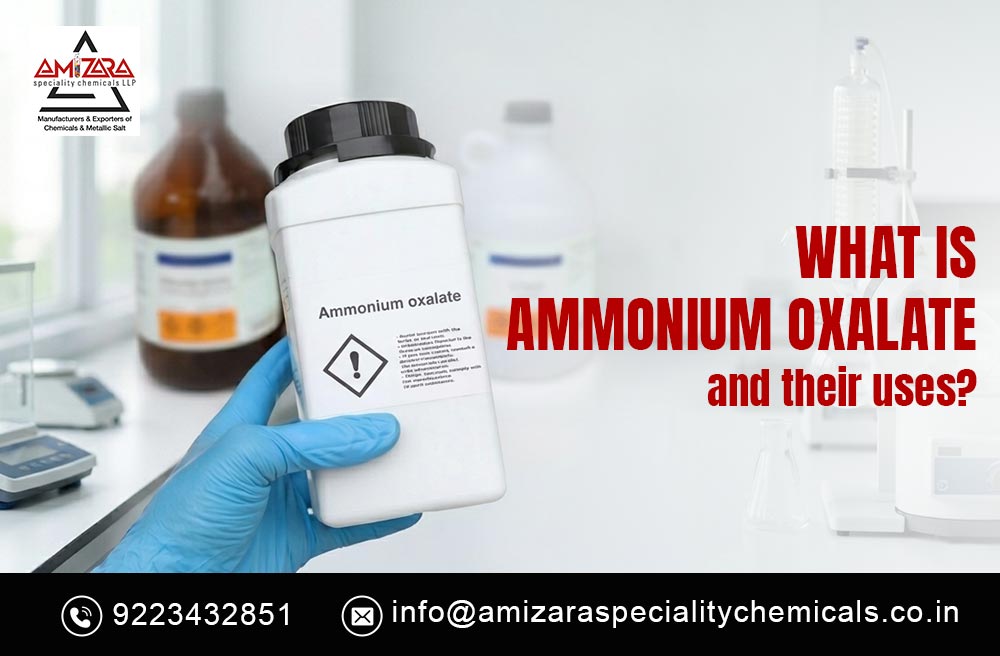
In the field of industrial chemicals and laboratory reagents ammonium oxalate is a key chemical that is extensively used in the textile processing industry, analytical labs as well as metal treatment and pharmaceutical applications. Because of its diverse chemical properties, industries constantly look for a reliable ammonium oxalate manufacturer which can supply extremely pure materials for research and industrial reasons. In the same way various factors like the quality, purity packaging, and the demand for global markets significantly affect the ammonium oxalate’s price on the market for chemical products.
On this page, we at Amizara Speciality Chemicals LLP look at the ammonium Oxalate formula and its properties, as well as industrial applications, manufacturing significance and safety guidelines in greater detail.
What is Ammonium Oxalate?
Ammonium oxalate, one of the inorganic chemicals that is formed by oxalate and ammonium Ions. It is typically accessible as a white crystal powder that is extremely water-soluble. It is non-odorous and mostly employed in industrial and laboratory chemical processing.
The ammonium Oxalate formula is:
(NH4)2C2O4(NH_4)_2C_2O_4(NH4)2C2O4
The chemical is also referred to as diammonium oxalate. It may be found in hydrated forms, like ammonium oxalate monohydrate. It functions as an analytically important reagent, as well as reduction agent in various industries.
Physical and Chemical Properties of Ammonium Oxalate
Some of the most significant characteristics of ammonium oxalate are:
- Chemical Formula: (NH4)2C2O4
- Molecular Weight: 124.1 g/mol
- Appearance: White solid
- Solubility Water Solubility: Soluble in water
- Odor: Odorless
- Nature: A little acidic
- Stability: Stable when stored under the recommended conditions for storage
Ammonium oxalate breaks down when heated and may release the nitrogen oxide and ammonia fumes. So, a proper storage and handling is essential when working in industrial environments.
How is Ammonium Oxalate Manufactured?
Ammonium Oxalate is usually made by neutralizing Oxalic acid using ammonium hydroxide, or ammonia solution. Ammonium oxalate is formed by the reaction crystals following evaporation and crystallization.
The simplest reaction is:
H2C2O4+2NH4OH-(NH4)2C2O4+2H2OH_2C_2O_4 + 2NH_4OH \rightarrow (NH_4)_2C_2O_4 + 2H_2OH2C2O4+2NH4OH-(NH4)2C2O4+2H2O
Industrial manufacturers make sure to maintain high purity standards in their production, as the chemical is widely used in labs and special chemical applications.
Major Uses of Ammonium Oxalate
1. Analytical Laboratory Reagent
One of the most important uses for ammonium oxide is in the analytical chemistry labs. It is an instrument for identifying and measuring lead, calcium, as well as rare earth metals. This compound is able to react with calcium ions, resulting in calcium oxalate precipitate. This makes it a valuable tool for the analysis of quantitative and qualitative.
Laboratories favor high-purity products from a reputable ammonium oxalate manufacturer to ensure precise results from the analysis.
2. Blood Testing and Anticoagulant Applications
Ammonium Oxalate is used extensively as an anticoagulant for collecting blood samples. It stops bleeding by binding the calcium ions within blood plasma. Because calcium plays an essential part in coagulation, eliminating free calcium can prevent the formation of clots.
Diagnostic centers and medical labs employ ammonium oxide for specific procedures for testing hematology.
3. Textile and Dyeing Industry
The textile industry utilizes ammonium oxalate for printing and dyeing. It improves the penetration of dyes and also acts as a cleaning and bleaching aid during processing.
Many manufacturers of textiles compare the price of ammonium oxide before purchasing bulk quantities, as large-scale textile production requires consistent chemical supplies and cost effectiveness.
4. Metal Cleaning and Polishing
Ammonium Oxalate is utilized for metal surface treatment and polishing processes. It assists in removing oxide deposits, rust stains and impurities in metal from metal equipment and surfaces.
Industries that deal with metal finishing and precision engineering depend on top-quality chemicals from reputable suppliers for greater cleaning efficiency.
5. Photography and Printing Industry
In specific printing and photography applications, ammonium Oxalate acts as a reduction agent as well as an image processing chemical. While digital technology has slowed its use, it is useful in the laboratory and industrial photography fields.
6. Chemical Manufacturing Industry
It is utilized to make other oxalate-based chemical and specific formulations. It is used like an intermediary in a variety of chemical synthesis procedures in the industrial sector.
Importance of Choosing a Reliable Ammonium Oxalate Supplier
When buying industrial chemicals, consistency and quality are critically crucial. A reliable ammonium suppliers of oxalate assures:
- Standards of high purity
- Secure packaging
- Timely delivery
- Competitive pricing
- The compliance with industrial regulations
- Technical assistance for industrial applications
Industries like pharmaceuticals, laboratories and specialty chemical manufacturers require secure supply chains in order to ensure unbroken production processes.
Factors Affecting Ammonium Oxalate Price
Many factors affect the ammonium oxide price on both international and domestic markets, such as:
-
Raw Material Costs
The price of oxalic acid and ammonia directly impact the manufacturing costs.
-
Purity Grade
Ammonium Oxalate that is laboratory-grade generally is more expensive than industrial-grade material.
-
Packaging Requirements
Customized packaging for export and bulk packaging impact pricing.
-
Market Demand
Demand from the laboratories as well as textile and specialty chemical industries can affect overall market rates.
-
Transportation and Logistics
International freight rates also impact the final price of the product.
Businesses seeking long-term supply agreements typically choose trusted manufacturers who offer low prices, and high-quality products that are consistent.
Safety and Handling of Ammonium Oxalate
Ammonium Oxalate can be used for numerous industrial applications, the proper precautions must be taken when handling.
Safety Guidelines
- Wear protective eyewear and gloves
- Beware of inhaling dust.
- Keep it in dry and cool conditions.
- Beware of agents that oxidize
- Use proper ventilation during handling
Contact with the eyes or skin could result in irritation. In addition, prolonged exposure can affect your the health of the individual. Industrial workers should adhere to Material Safety Data Sheet (MSDS) guidelines while working with the chemical.
Storage Recommendations
To ensure chemical stability and quality, Ammonium oxide should be stored as follows:
- In containers that are tightly sealed.
- Keep clear of humidity
- Stay away from sources of heat
- In a space with ventilation
Proper storage can prevent the contamination and breakdown that occur in chemicals.
Ammonium Oxalate is an incredibly versatile industrial chemical employed in analytical laboratories for blood testing, processing of textiles as well as metal treatment and manufacturing of specialty chemicals. Its unique chemical properties and wide range of industrial applications make it a crucial chemical across a variety of industries.
Knowing the ammonium oxalate formula and industrial applications, safety measures and trends in the market can assist businesses in choosing the most suitable product for their specific requirements. Working with a dependable ammonium oxalate provider can also guarantee consistency in product quality, a competitive ammonium-oxalate pricing as well as dependable industrial support.
With Amizara Speciality Chemicals LLP, industries can find Ammonium Oxalate of the highest quality, that are designed to meet the latest demands of laboratory and industrial.
FAQ
1. How do I calculate the ammonium oxide formula?
The ammonium Oxalate formula is (NH4)2C2O4 composed of ammonium ions as well as oxalate Ions.
2. What are the most important applications of ammonium oxalate?
Ammonium oxalate can be found in analytical labs for testing blood, textile dyeing polishing of metals, and other manufacturing processes that require specialty chemicals.
3. Are ammonium oxalate and ammonium oxalate dangerous?
Incorrect handling can cause eye, skin and respiratory discomfort. A proper protective device should be worn.
4. What factors influence ammonium oxide price?
The ammonium oxide price is based on the purity, raw material cost, packaging, demand on the market, and logistics.
5. How can I select the most reliable supplier of ammonium oxalate?
Select an experienced ammonium oxalate provider which offers top-quality products with safe packaging, cost-effective pricing and reliable delivery services.





Recent Comments